


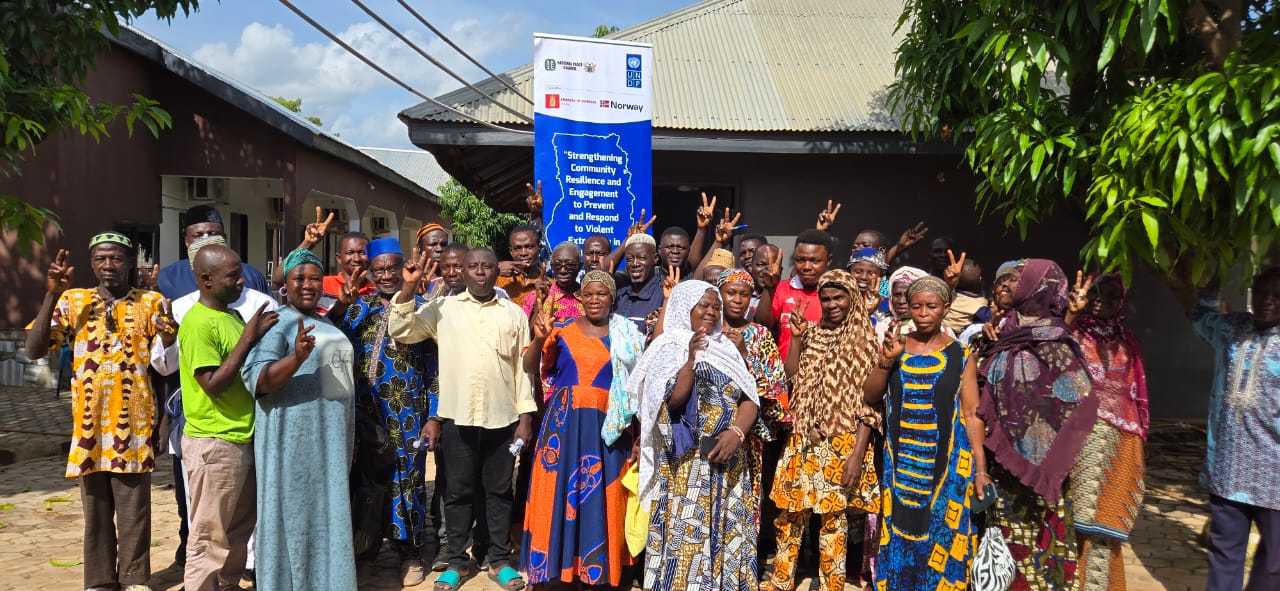
The Upper West Regional Peace Council (UWRPC), with support from the United Nations Development Programme (UNDP) under the Preventing and Responding to Violence Extremism in the Atlantic Corridor Project with funding support from the Governments of Norway and Denmark, has intensified efforts to strengthen community resilience against violence extremism through series of community outreach programmes held in Gwullu and Tumu on 29 and 30 June 2025.

The initiative brought together religious leaders, women, youth, Community Peace Committees (CPCs), assembly representatives and community members from Gwollu, Puzene, Fatchu, Kupulima, Jitong, Wuru and surrounding communities.
The outreach formed part of the UNDP-supported Atlantic Corridor Project, which seeks to strengthen local capacities for conflict prevention, promote peaceful coexistence and reduce vulnerabilities to violent extremism in border communities.
Recognizing the growing security challenges in the Upper West Region including cross-border threats, farmer-herder conflicts, youth unemployment, misinformation, land disputes and chieftaincy-related tensions, the Regional Peace Council continues to work with communities to build sustainable peace through inclusive dialogue and community ownership.
Speaking during the outreach, officials of the Upper West Regional Peace Council emphasized that peace building is a shared responsibility requiring the active participation of every segment of society. Participants were encouraged to openly discuss emerging security concerns while identifying practical solutions that communities themselves could implement to strengthen social cohesion and prevent violence.One of the highlights of the programme was a participatory peace and conflict mapping exercise, where community members identified both the strengths and vulnerabilities within their localities. Participants recognized religion, traditional leadership, women peace circles, community dialogue platforms, churches and mosques as important peace assets.
At the same time, they pointed to persistent challenges including land disputes, farmer-herder conflicts, youth unemployment, political differences, drug abuse, poor communication and misinformation as factors capable of undermining community stability if left unaddressed.
The outreach also underscored the critical role of faith leaders in promoting peaceful coexistence. The participants reflected on scriptural teachings that encourage peace, justice, forgiveness, respect for human life and love for one’s neighbour.
Religious leaders pledged to use their pulpits, churches and mosques to spread messages that discourage hate speech, violent extremism and intolerance while promoting dialogue and mutual respect among diverse religious communities.Interfaith dialogue sessions further strengthened collaboration between religious leaders. Participants reaffirmed their collective commitment to promoting unity and addressing misconceptions that often fuel conflict.
Participants described the initiative as a timely intervention that has deepened understanding, strengthened relationships and created opportunities for sustained cooperation among religious institutions in the region.Recognising women and young people as indispensable actors in peace building, dedicated sessions focused on enhancing their participation in community peace initiatives.
Women proposed expanding Women Peace Circles, strengthening family mediation and increasing community sensitisation on peaceful conflict resolution.
Youth participants committed themselves to becoming ambassadors of peace by reporting suspicious activities through established community reporting mechanisms and promoting non-violent approaches to resolving disputes.An important outcome of the outreach was the development of practical Community Peace Action Plans.
Working in groups, participants agreed to organize regular interfaith dialogue meetings, strengthen Community Peace Committees, promote collaboration between traditional and religious leaders, encourage greater participation of women and youth in peace building, and intensify community sensitisation on peaceful conflict resolution. These locally developed action plans are expected to reinforce existing early warning and early response mechanisms while strengthening community ownership of peace building efforts.
The programme recorded several significant achievements, including increased awareness on preventing violent extremism, improved collaboration between Christian and Muslim leaders, enhanced participation of women and youth in peace initiatives, strengthened relationships between communities and security agencies, renewed commitment to early warning systems, and greater community ownership of local peace building interventions.Participants also highlighted lessons learned during the engagement, noting that faith leaders remain among the most trusted peace actors within communities, while structured community dialogue continues to be one of the most effective tools for strengthening social cohesion.
Women were recognized as valuable sources of local knowledge for early warning systems, and young people demonstrated a strong willingness to champion peace when provided with meaningful opportunities for engagement.Although challenges such as transportation constraints, language interpretation needs and limited discussion time were encountered, participants unanimously recommended sustaining the initiative through regular faith-based community outreaches, institutionalized interfaith dialogue platforms, refresher training for Community Peace Committees, enhanced support for women and youth peace networks, and stronger collaboration between communities and security agencies.
The Upper West Regional Peace Council reaffirmed its commitment to working closely with communities, development partners and state institutions to promote lasting peace across the region.
Through continued partnership with UNDP under the Atlantic Corridor Project, the Council remains dedicated to strengthening local capacities for conflict prevention, enhancing social cohesion and building resilient communities capable of resisting violent extremism.
By: Pontianus Aabe-inir