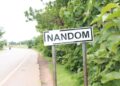



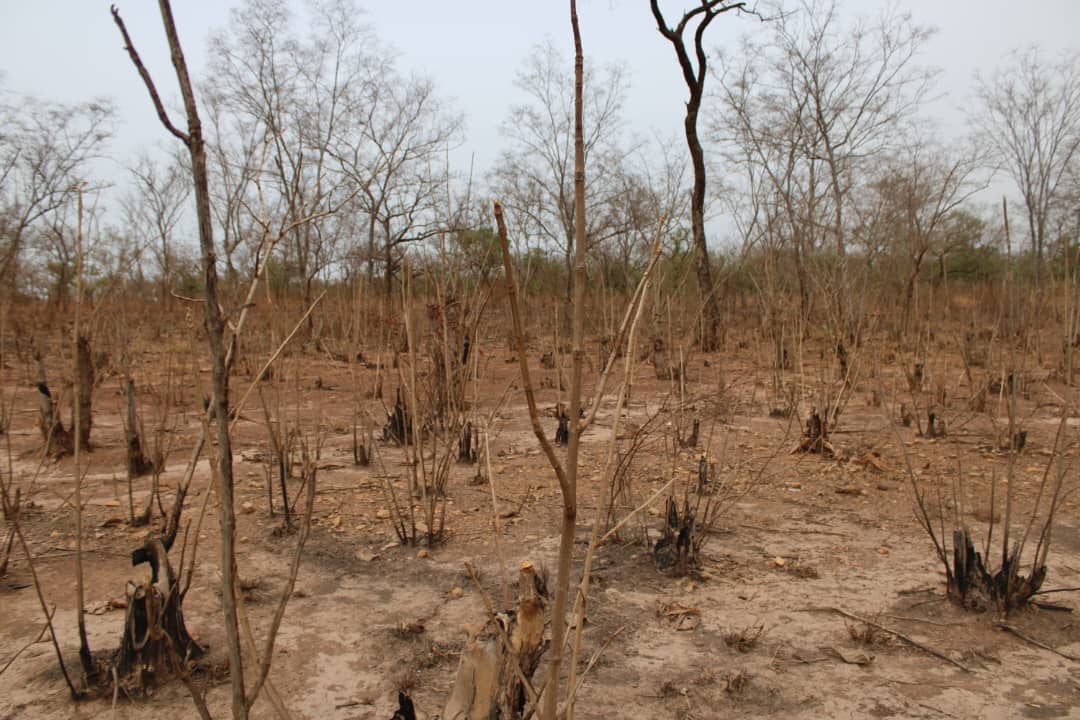
The dry season has laid bare a growing environmental crisis along the stretch between Brutu in the Nandom Municipality and Lambussie in the Lambussie District, where large sections of what was once a dense forest have been cleared.

What used to be a continuous expanse of greenery is now increasingly interrupted by open, degraded land. In some parts, entire sections of forest have been wiped out.
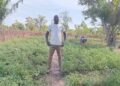
Field observations reveal widespread evidence of human activity driving the destruction. Tree stumps, burnt patches of land, and scattered logs point to ongoing logging, charcoal production, and land clearing for farming.
“This is not an isolated case,” a local observer noted during a recent visit to the area. “You see it over and over again — the forest is being broken piece by piece.”
For many residents, however, the situation reflects a difficult trade-off between environmental protection and survival. Charcoal burning and farming remain key sources of livelihood, especially during the dry season when agricultural activity slows.
Yet, the long-term consequences are becoming increasingly visible. With the loss of tree cover, the land is left exposed to extreme heat, soil degradation, and erosion. The disappearance of vegetation also threatens local biodiversity, as habitats for birds and other wildlife are steadily destroyed.
Environmental concerns are now being raised about the pace and scale of the clearing, as well as the apparent lack of enforcement or intervention.
“This is happening in plain sight,” the observer added. “The question is — who is taking responsibility, and what is being done to stop it?”
The situation between Brutu and Lambussie reflects a broader challenge facing many rural communities, where economic survival often comes at the cost of environmental sustainability.
If current trends continue, residents fear that the remaining patches of forest could disappear within a few years, leaving behind vast stretches of degraded land.
The unfolding reality serves as a stark reminder of the urgent need for sustainable land-use practices, stronger regulation, and community-based solutions to protect what remains of the forest.
Without immediate intervention, the forest between Brutu and Lambussie may soon exist only in memory — a loss not just of trees, but of ecological balance and future security.