


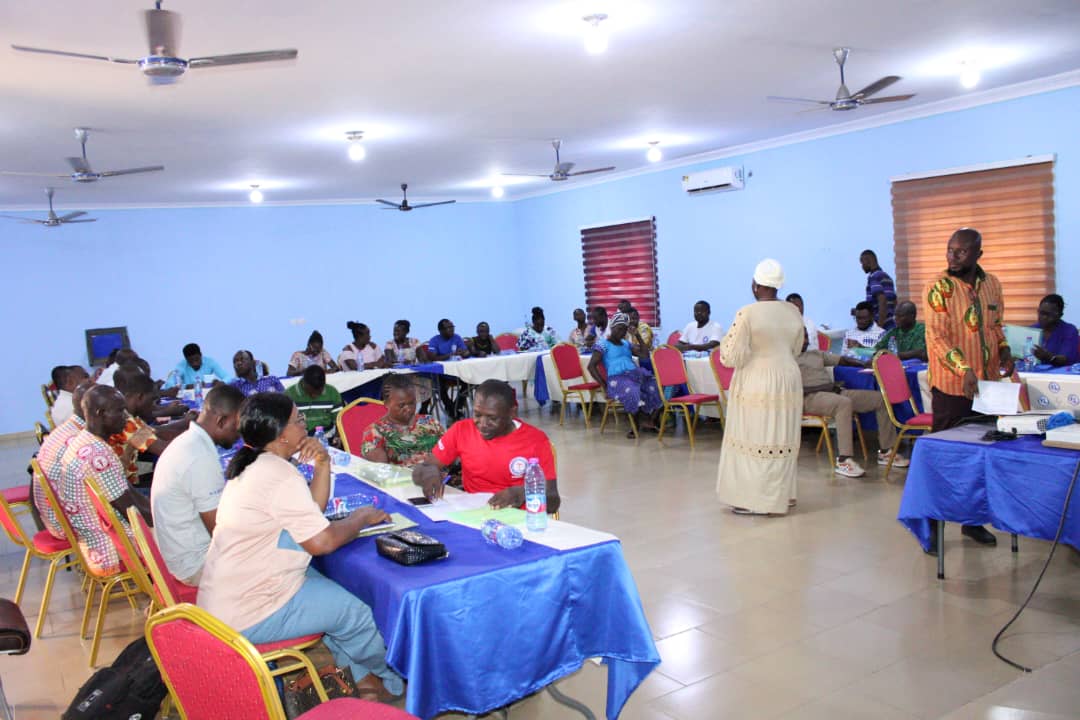
The Health Services Workers’ Union (HSWU) has intensified efforts to strengthen its grassroots leadership in the Upper West Region through a series of capacity-building workshops for branch executives.

The latest two-day training, held in Nandom on April 22 and 23, 2026, brought together participants from various health facilities, including the Nandom Hospital, Municipal Health Directorate, Midwifery Training College, and representatives from Lambussie and Lawra. The initiative forms part of a broader national strategy to equip union leaders with the skills and knowledge required to effectively represent members.
Regional Chairman of HSWU, Mr. Bashiriddin Ahmed Sahel, said the training is deliberately structured to build leadership capacity from the ground up.
“We are here to equip our branch executives with knowledge. When you give someone a leadership position, you need to guide them so they can interact well with members and avoid issues,” he stated. “This is the second session in the region—we’ve already been to Tumu, now we are in Nandom, and we will move to other districts. The goal is to train executives so they can also train members at the grassroots. Basically, we are training the district.”
Echoing this, Brother Edward Kuuberme Naapong, First Trustee of HSWU in the Upper West Region and Chairman for the Lambussie Branch, noted that the training addresses key gaps in leadership and communication among local executives.
“This training is to help them understand their responsibilities and how to communicate effectively through the union structure to channel issues to the national level,” he explained, adding that occupational health, safety, and environmental concerns are also central to the discussions.
Participants say the workshop has significantly improved their understanding of union operations. Sister Margaret, one of the attendees, highlighted the importance of unity in advocating for better conditions of service.
“As individuals, we cannot fight alone. The union has been instrumental in securing benefits like salary increments. This training has shown us the importance of coming together and communicating effectively with our members,” she said.
Facilitator and Wa Municipal Hospital Branch Chairman, Brother Emmanuel Kaleo, described the training as enlightening, noting that it clarified both responsibilities and entitlements of union members.
“Everything that was unclear has now been explained. We are now better positioned to function effectively,” he said.
From the Nandom Branch, Chairman Brother John Paul Beyuo emphasized the collaborative nature of the training, which grouped participants from different facilities to share experiences and ideas.
“It has been a real eye-opener. We believe this will improve how we operate and engage our members,” he noted.
At the national level, Sister Harriet Sobuor, Head of Women and Gender at the HSWU-TUC National Secretariat in Accra, underscored the importance of continuous training in modern trade unionism.
“Trade unionism has evolved. It is no longer about making noise but about presenting data and engaging constructively,” she said. She revealed that the union trained 500 executives last year and is currently training another 500 across the country.
She also highlighted the introduction of a Tier 3 Provident Fund to support members during times of distress, and reaffirmed the union’s inclusive approach, covering over 110 categories of health workers.
The HSWU leadership maintains that sustained investment in training will strengthen its base, improve advocacy, and ultimately enhance the welfare of health workers nationwide.
By Staff Reporter