


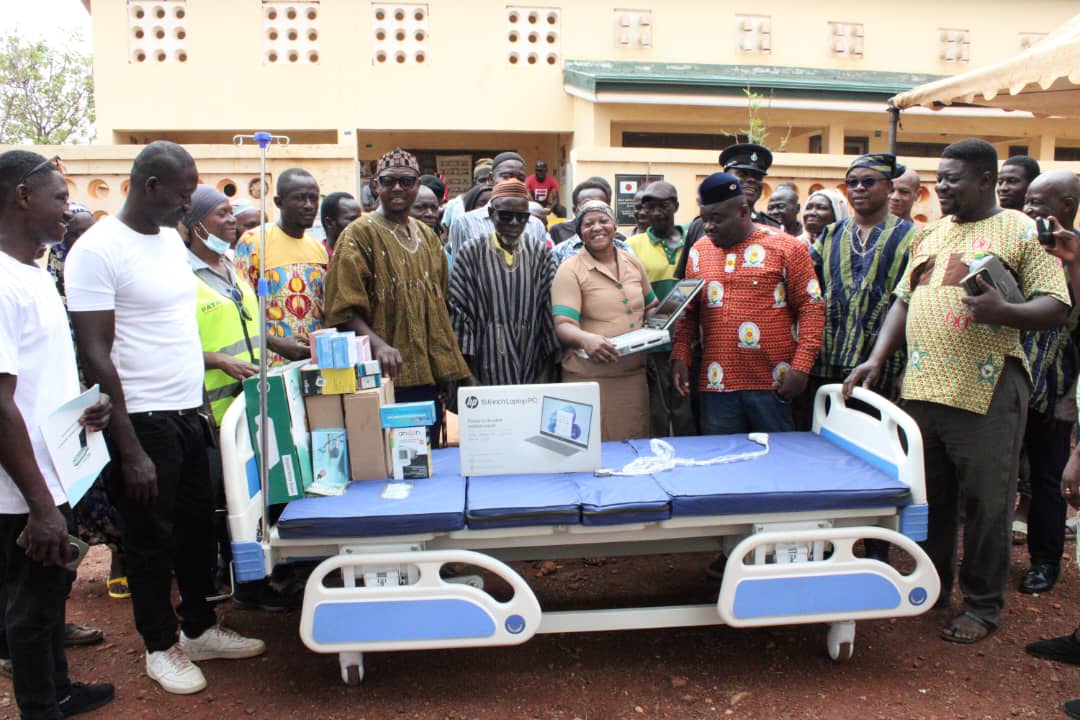
Healthcare delivery in parts of the Lambussie District is expected to improve following the delivery of essential medical equipment to the Nabaala and Tapumu Community-based Health Planning and Services (CHPS) compounds on Wednesday, April 29 and Thursday, April 30, respectively.

The items were handed over by a joint team from the Lambussie District Assembly and the District Health Directorate as part of efforts to strengthen primary healthcare services at the community level.
The equipment includes fingertip pulse oximeters, blood pressure monitors, examination couches, hospital beds, delivery sets, fetal Dopplers, and an ultrasound scan machine. Other items provided are an autoclave for sterilization, infrared thermometers, weighing scales for adults and infants, and a laptop to support health data management.
Until now, expectant mothers in Nabaala, Tapumu, and surrounding communities had to travel to Hamile, Lambussie, or Fielmuo to access ultrasound services. This situation often resulted in delayed diagnosis and increased financial and physical strain on pregnant women.
Residents have described the development as a significant relief.
Madam Bawiise Adwoa, a resident, recalled the difficulties women previously faced in accessing maternal health services.
“We used to travel long distances just to do pregnancy scans. It was costly and stressful for us,” she said.
At Tapumu, Madam Jaa Pascaline welcomed the intervention, noting its immediate impact on her access to care.
“This equipment has come at the right time. I can now do my scan right here in Tapumu without travelling to Fielmuo or Hamile. This will save me money and stress,” she said.
The Nabaala Kuoro, Alhaji Siinayor Aboubakar, also commended the initiative, emphasizing its importance for maternal healthcare in rural communities.
“This support will help bring essential services closer to our people, especially pregnant women who previously had to travel long distances for care,” he said.
Health officials indicate that the availability of the equipment at the CHPS level will significantly enhance maternal and child healthcare delivery, improve diagnostic capacity, and strengthen emergency response services, particularly in hard-to-reach communities with limited access to higher-level facilities.
To ensure effective use of the ultrasound machines and address concerns about technical capacity at the facility level, a midwife from each CHPS compound will be trained to operate the equipment.
The intervention forms part of a broader support package under the Coastal States Stability Mechanism (CSSM), which also includes two police patrol vehicles, ten motorbikes, and 680 dual desks distributed to ten basic schools in the district.
At a separate ceremony held at the Lambussie District Assembly forecourt, the District Chief Executive formally received the items on behalf of the district before their distribution to the Ghana Police Service, Ghana Health Service, and beneficiary institutions.
Authorities say the police patrol vehicles will enhance security operations and response times, particularly in border communities such as Hamile and Koro. The motorbikes are expected to improve field supervision and community-level engagement by security and health personnel.
The 680 dual desks are intended to address furniture shortages in basic schools and improve learning conditions for pupils across the district.
Lambussie District, a border district classified as high-risk, continues to face development challenges including limited infrastructure, gaps in healthcare and education delivery, and security vulnerabilities. The CSSM programme, implemented by the International Organization for Migration (IOM) with support from international partners, seeks to address these gaps by strengthening public service delivery and enhancing state presence in vulnerable communities.
District officials say the combined interventions are aimed at improving living conditions and building resilience across the district.